Business Plan 2025/26 – 2026/27
March 2026
Business Plan 2026-27 – April 2026.pdf
Download pdf (958.02 KB)
This document may not be fully accessible.
Environmental Standards Scotland (ESS) is an independent body set up to ensure the effectiveness of environmental law, and prevent enforcement gaps arising from the UK leaving the European Union.
More about usOur aim is to publish as much information as we can about the work that we do.
In this section you will find various publications relating to our corporate governance, investigations and analytical work.
You will also find all minutes from our Board and Audit and Risk Committee meetings.
Our workOne of the ways in which we carry out our function is to investigate environmental concerns made to us.
In this section, find out what we can investigate, how to raise a concern and what cases we are currently working on.
Raise a concernKeep up to date with all the latest news about Environmental Standards Scotland (ESS) including latest publications, latest videos, blogs, investigation launches, calls for evidence and related information.
News
March 2026
Business Plan 2026-27 – April 2026.pdf
Download pdf (958.02 KB)
This document may not be fully accessible.
I am pleased to present the ESS Business Plan for 2026/27.

ESS Chief Executive Officer, Mark Roberts
This Business Plan (the Plan) is the first that is aligned with our newly published ESS Strategy 2026-2031 and sets out our ongoing work and key priorities for the year ahead.
Alongside our new Strategy, we are publishing this Plan together with a suite of updated governance and corporate documents, including our refreshed performance indicators, our theory of change framework, our statement on the Code of Practice for Statistics and our new Communications and Engagement Plan. Together, these documents outline the governance and organisational direction that will guide ESS over the coming years, including information on how we will show the impact of our work and communicate with our key audiences.
This Plan covers the period during which ESS assumes two new functions. We will be the new independent review body responsible for scrutinising progress towards Scotland’s new statutory biodiversity targets, as set out in the Natural Environment (Scotland) Act 2026. We will also scrutinise local authorities’ reporting against climate change duties as set out in the Climate Change (Scotland) Act 2009.
This represents a significant expansion of our functions and is accompanied by an increase in our budget to support these new duties.
I am confident that the actions set out in this Plan will further strengthen ESS, support the successful implementation of our new Strategy, and ensure we integrate and deliver our expanded scrutiny functions effectively. Of course, central to our success will be the ongoing commitment and hard work of the ESS staff and I look forward to working with them and our Board, to deliver on this Plan together.
Mark Roberts
Chief Executive of ESS
1.1
Environmental Standards Scotland (ESS) is a Non-Ministerial Office established under the UK Withdrawal from the European Union (Continuity) (Scotland) Act 2021 and accountable to the Scottish Parliament.
1.2
Our role is to monitor, investigate and secure public authorities’ compliance with environmental law in Scotland. We also scrutinise the effectiveness of environmental law and policy in Scotland and how it is implemented and applied. In our investigative and analytical reports, we may also identify instances where we consider there to be gaps in environmental protection legislation.
1.3
To deliver on these responsibilities ESS previously worked to the Strategic Plan 2022-25, which set out our approach from the point the organisation was originally established in 2021. This first three-year plan concluded within this reporting period and has been succeeded by our new five-year Strategy 2026-2031.
1.4
Due to this cross-over period, this Business Plan will consider both achievements from the final year of the Strategic Plan 2022-25, alongside key priorities for the first year of the Strategy 2026-2031, through to March 2027.
2.1
During the period covered by this Plan, there will be a Scottish Parliament election. There will be a significant turnover of Members of the Scottish Parliament (MSPs) and the establishment of new committees by the new Parliament and potentially a new legislative programme. ESS will work with the new committees of the Parliament to ensure that its accountability to the Parliament operates effectively.
2.2
The Plan will also cover the preparation, integration and delivery of new aspects of scrutiny for ESS. This includes scrutinising local authorities’ delivery and reporting of their climate change duties and acting as the new Independent Review Body for scrutinising progress towards the delivery of Scotland’s statutory targets for nature recovery. Our prioritised objectives will ensure ESS is ready to meet and report on these new responsibilities.
3.1
Our Strategy 2026-2031 sets out how we will work as an organisation to deliver a series of strategic objectives which, together, will help us progress towards achieving our Vision.
3.2
We will report our progress publicly through our annual Business Plans, alongside our Annual Report and Accounts. We will also update the Scottish Parliament directly on our progress with videos, Committee appearances and written correspondence, all of which we publish on the ESS website.
3.3
As set out in the ‘our work’ section below, a review of the Strategic Plan took place across 2025/26 culminating in the publication of our new Strategy in March 2026. An overview of our revised approach is summarised on the next page.
3.4
ESS’ vision is:
3.5
Our Principles set out that we will:
3.6
We have set key priorities going forward:
3.7
We will continue to consider all representations raised with us by members of the public on any environmental topic. We will signpost people to relevant organisations if their concern does not fall within our remit.
3.8
Alongside this work we took the opportunity to also review our approach to communications and performance management, culminating in the development of a new Communications and Engagement Plan and updated key performance indicators and performance management indicators.
4.1
ESS’ Chair Dr Richard Dixon leads a Board made up of six other members. Our Board meets regularly and the minutes of its meetings are available on our Publications page, as are the minutes of the Audit and Risk Committee.
4.2
ESS is accountable to the Scottish Parliament and has a legal duty to report on its activities each year. As a body corporate, ESS operates in line with the Public Finance and Accountability (Scotland) Act 2000 and has a duty to produce annual accounts in line with the Government Financial Reporting Manual. All Annual Reports and Accounts are published on the ESS website alongside all other corporate and governance reports.
4.3
The ESS Chief Executive Officer (CEO) Mark Roberts, is the Accountable Officer for ESS. The CEO is responsible to the Scottish Parliament for: the propriety and regularity of ESS’ finances; the economical, efficient and effective use of the resources placed at its disposal; and for signing ESS’ accounts.
4.4
Deloitte LLP provides the external audit function for ESS on behalf of Audit Scotland. Scottish Government Internal Audit provides an audit advisory service to the Accountable Officer and the Audit and Risk Committee.
5.1
ESS’ Business Plan for the period from April 2025 to March 2026 was published in April 2025. Set out below are the key pieces of work which were identified for the financial year 2025/26. A progress update is included alongside each item.
| Key piece of work set out in the 2025/26 Business Plan | Progress on key pieces of work | |
| Ensuring compliance and effectiveness | Pursue identified failures to comply with environmental law with the relevant public authorities. | ESS has identified areas of non-compliance with environmental law. We have worked with the public bodies concerned to ensure that the improvements required are implemented in full and on schedule. Full details of the completed cases where we have identified non-compliance, and the action taken to ensure improvements have been implemented, are published on the investigations reports webpage. |
| Continue to resolve matters by agreement with the relevant public authorities where possible, within a reasonable timescale. | ESS has actively engaged with public bodies and reached informal resolution on a range of issues relating to compliance with, and implementation of, environmental law. Full details of the completed cases where we have reached informal resolution are published on the investigations reports webpage. | |
| Use ESS’ statutory powers to secure changes and remedial actions to address poor compliance and address environmental risks. | No compliance failures requiring formal enforcement action have been identified to date. | |
| Where our investigations identify systemic patterns of compliance failure, or areas where the law is ineffective in protecting the environment or public health, pursue this directly with the relevant parts of the Scottish Government. | No issues requiring formal enforcement action have been identified to date. | |
| Seek to resolve matters and secure the necessary improvements by agreement with the Scottish Government, and where this is not possible within a reasonable timescale, use ESS’ statutory powers to prepare and issue improvement reports to the Scottish Parliament. | ESS has actively engaged with the Scottish Government and reached informal resolution on a range of issues relating to the implementation of environmental law. Full details of the cases where we have reached informal resolution are published on the investigations reports webpage. | |
| Investigating environmental concerns |
Assess the outcome of the Scottish Government’s work on ‘Ramsar’ site protection. | Completed. |
| Publish the outcome of our investigation into the classification of Special Protection Areas. | Investigation fieldwork has concluded and the public authority has been invited to resolve informally the findings of the investigation. | |
| Publish the outcome of our investigation into the sustainable management of fisheries. | Investigation fieldwork has concluded and the public authority has been invited to resolve informally the findings of the investigation. | |
| Commence assessment of how Scottish public authorities implement their legal obligations in respect of public registers. | Completed. | |
| Commence assessment of the contaminated land regime in Scotland. | Completed. | |
| Carefully review and assess all representations to identify candidates for investigation and advise on alternative routes for cases not suitable for investigation. | The outcome of all representations we receive are published on the representations received webpage. | |
| Regularly review and publish our forward work programme so that we are investigating the most important environmental concerns. | Details of all our ongoing casework are published on the investigations reports webpage. | |
| Regularly update our publicly available register of investigations and carry out these investigations. | Details of all our ongoing and completed investigations are published on the investigations reports webpage. | |
| Continue to monitor the response of public authorities to ESS’ recommendations. | Details of the outcome of ESS’ monitoring of public authorities’ implementation of recommendations are published on the investigations reports webpage. | |
| Continue to actively support parties submitting representations, particularly where they are unfamiliar with ES processes, to ensure their concerns are accurately captured. | In accordance with ESS’ service standards, a senior investigator is appointed to deal with each environmental concern that is raised with the organisation. This ensures that dedicated and ongoing support, including regular updates, is available to everyone who submits a representation to us. These standards are published on the service standards webpage. | |
| Keep those who have made representations informed about our consideration and investigation of their matter of concern. | Those submitting representations are kept updated on the representations they bring to ESS and the outcome is published as set out above. | |
| Publish reports about the issues we have investigated and the actions that have been taken. | Reports on all our completed investigation work are published on the investigations reports webpage. | |
| Continue to assess our systems and processes to ensure the effectiveness of our investigations. | Our systems and processes continue to be assessed on an annual basis. | |
| Monitoring and evaluating environmental performance and change in Scotland |
Contribute to Stage 1 Parliamentary scrutiny of the Natural Environment (Scotland) Bill (including proposals to designate ESS as the Independent Review Body responsible for scrutinising progress towards targets for nature recovery). | Completed.
ESS responded to the Rural Affairs and Islands Committee’s Call for Views on 8 May 2025 and ESS officials gave oral evidence to the committee during stage 1 on 28 May 2025. |
| Contribute to Parliamentary scrutiny of the Scottish Government’s Climate Change Plan (CCP). | Completed.
The ESS Chair and officials gave evidence to the Net Zero and Transport Committee on the draft CCP on 25 November 2025. ESS also responded to the Scottish Government consultation on the draft CCP on 29 January 2026. |
|
| Contribute to Stage 2 and 3 Parliamentary scrutiny of the Natural Environment (Scotland) Bill. | Completed. | |
| Publish the outcome of our analytical work on threats to the marine environment (focused on seafloor integrity). | Ongoing.
Analytical work has been progressed, with further work continuing and a final report expected to be published in 2026/27. |
|
Deliver a programme of analytical work on priority issues identified in ESS’ approved Strategic Plan, including:
|
Ongoing.
Analytical work has been progressed on a range of topics including:
ESS wrote to the Cabinet Secretary for Climate Action and Energy in October 2025 recommending that the Scottish Government commit to updating the INNS code of practice by May 2027. |
|
Monitor the response of public authorities to recommendations made in analytical reports published in 2023/24 and 2024/25, including
|
Completed.
ESS has received information from a number of public authorities on the implementation of their response to recommendations made in analytical reports on air quality, sewage discharge, soil health, marine litter and INNS during the year. Details of the outcome of ESS’ monitoring of public authorities’ implementation of recommendations on the monitoring and analytical work webpage. |
|
Respond to relevant consultations and will contribute to parliamentary scrutiny of proposed changes to environmental law, including:
|
Completed.
ESS responded to 10 consultations and calls for views on a wide range of topics during the year. Responses are published on Our monitoring and analytical work – Environmental Standards Scotland webpage. ESS continues to engage with the Scottish Government, SEPA and Scottish Water on proposed changes in respect of water, wastewater and drainage, and the Integrated Authorisation Framework. |
|
| Monitor developments in European and international law and regulation and commission an assessment of the extent to which there is alignment between environmental standards, laws and regulations in Scotland and the European Union or other international best practice. | Completed.
ESS has continued to monitor developments in the European Union (EU) and international environmental law and, where relevant, has included reference to developments in responses to consultations and calls for views and in correspondence with public authorities about the implementation of recommendations in ESS reports. In addition, in October 2025 ESS commissioned an evaluation of the extent to which Scotland has maintained alignment with EU and other international best practice. A final report from consultants is expected in March 2026 and is expected to be by ESS published later in the financial year. |
|
| Further develop and maintain effective systems for monitoring data and evidence on environmental performance, including Scotland’s comparative performance | Our systems and processes continue to be assessed on an annual basis. | |
| Further develop and maintain effective working relationships with a range of organisations involved in collating, analysing and publishing data and evidence on environmental performance in Scotland. | ESS has been proactive in liaising with a range of organisations working on data and evidence on environmental performance in Scotland during the course of the year including public authorities, research institutes and universities and scrutiny and oversight bodies in the rest of the UK and the EU. | |
Engaging and communicating effectively about our role and how to raise concerns |
Review and publish a new Communication and Engagement Plan, linking to the development of the new Strategy, to set out ESS’ approach to:
|
ESS published its Communication and Engagement Plan in March 2026 alongside the publication of its Strategy 2026-2031.
The plan includes ESS’ engagement priorities, outlining how we will ensure our work is communicated clearly and effectively. It also contains detailed information on ESS’ key audiences and how we will engage with them throughout the duration of the new strategy. |
| Proactively increase the understanding of our role and how people can raise matters of environmental concern with us, through building on external feedback and piloting new approaches. | ESS published Easy Read documents throughout the year summarising how to submit a representation and our whistleblowing procedures.
We held in-person and online engagement sessions to support the collaborative drafting of our new strategy. ESS has increased its reach via connectivity with other environmental groups and in legal journals. ESS has launched a new email update for stakeholders so that they can receive the latest updates on their work of the organisation. |
|
| Proactively engage with the Scottish Parliament and relevant committees to increase awareness and understanding of our work. | ESS continues to proactively engage with Scottish Parliament and its Committees, primarily the Net Zero, Energy and Transport Committee, through appearances, consultation responses, updates through correspondence and through vlogs. This information is published on the ESS website.
ESS has proactively engaged with the annual MSP survey to analyse how it can best engage with MSPs and improve its profile with relevant committees. ESS has also engaged with the Rural Affairs and Islands Committee regarding the Natural Environment (Scotland) Act 2026. |
|
| Continue to provide and publish six-monthly updates to the Net Zero, Energy and Transport Committee in August and February each year. | ESS has provided and published six-monthly updates to the Net Zero, Energy and Transport Committee in both August and February. | |
| An effective and efficient organisation |
Review our existing governance and operational approach to work, linking to the development of the new Strategy, demonstrating our impact through performance management indicators and a theory of change approach. | ESS has reviewed and amended its performance management indicators (PMI’s) with a view to increasing clarity of reporting in alignment with Strategy 2026-2031.
The [theory of change] approach has been implemented across the organisation, accompanied by organisation-wide training. |
| Build on the implementation of the new Oracle finance system to enhance efficiency and financial planning opportunities. | Staff members attended training in the Oracle finance system.
New standard operating procedures have been created to reflect the requirements of Oracle and guidance has been made easily available to staff. |
|
| Implement the processes and policies for monitoring and minimising ESS’ impact on the environment, through developing phase two of the Sustainability Plan. | ESS’ Sustainability Action Plan was approved in April 2025.
Organisational Sustainability Champions have met throughout the year to monitor and deliver on commitments outlined in the plan. ESS applied for and was awarded bronze certification as a Carbon Literate Organisation in June 2025. |
|
| Support the Minister and Parliamentary process to appoint an additional Board member. | ESS successfully supported the recruitment of a new Board member Laura Anderson who will begin her appointment on 1 April 2026. | |
| Deliver the People Strategy action plan and equalities related initiatives. | ESS’ equality mainstreaming report was published in April 2025. The report has also been referenced in ESS’ new Strategy 2026-31 to underscore its organisational importance.
In the past year, ESS has improved both formal and informal staff feedback processes. Opportunities for staff have been reviewed and expanded where necessary to create a tailored offer. Systems have been regularly reviewed and updated to improve efficiency across the organisation. |
|
| Assess opportunities for longer-term financial flexibility and sustainability meeting public service reform principles | ESS has reviewed and improved its processes for contracting expert advice and procurement.
ESS reported £90,600 of public service reform savings in the financial year 2025/26. |
6.1
The sections below set out the key priorities and outputs that will be delivered from April 2026 to March 2027, in this the first year of the new Strategy 2026-2031. These actions will be reviewed quarterly and updated as required.
6.2
Objective 1 of the Strategy 2026-2031 outlines that ‘ESS has significant statutory powers to secure public authorities’ compliance with environmental law and to bring about improvements to the effectiveness of environmental law and how it is implemented or applied, with the aim of protecting and improving the environment and public health’.
6.3
We set out our intention to:
6.4
We will:
| Action | Time period | KPI |
| Seek to work constructively with public authorities where possible to reach agreement on action that will be taken to address ESS findings. | Ongoing | Performance
Profile |
| Follow-up on these actions to ensure they have been implemented. | Ongoing | Performance
Profile |
| Use our statutory powers to prevent further harm to, or reduce the risks to, the environment or public health. | Ongoing | Performance
Profile |
| Issue a compliance notice where we consider that: there has been a failure by a public authority to comply with environmental law; harm to the environment has been caused, is continuing to be caused, or is at risk of being caused as a result. | Ongoing | Performance
Profile |
| Prepare an improvement report where we consider that: there is a failure by one or more public authorities to comply with the law, or where a systemic change is required by the public authority(s) concerned to improve compliance with, and/or the effectiveness of, environmental law. | Ongoing | Performance
Profile |
| Consider the use of our power to make an application for judicial review, or intervene in civil proceedings taken by another party. | Ongoing | Performance
Profile |
| ESS’ new duties | ||
| Take steps to establish ESS’ new role in scrutinising local authorities’ reporting against their climate change duties, as set out in the Climate Change (Scotland) Act 2009. | Ongoing | Performance
Profile |
| Monitor implementation of the Natural Environment (Scotland) Act and take steps to establish the Independent Review Body function for reviewing progress against nature recovery targets within ESS. | Ongoing | Performance
Profile |
6.5
Objective 2 of Strategy 2026-2031 outlines the importance of our functions in ‘ensuring that we analyse and investigate the most important environmental concerns’ to protect that environment’.
6.6
We have two mechanisms to do this:
6.7
We also:
Key pieces of work for 2026/27
6.8
The table below sets out planned actions to meet this strategic objective.
We will:
| Action | Time period | KPI |
Conclude the resolution of our investigation into the:
|
April to June 2026
April to June 2026 |
Performance
Profile |
Conclude investigation into how:
|
January to March 2027 | Performance
Profile |
Conclude investigation fieldwork of the:
|
January to March 2027
July to September 2026 |
Performance
Profile |
Commence assessment of the:
|
July to September 2026 | Performance
Profile |
Deliver a programme of analytical work on priority issues, including:
|
Ongoing | Performance
Profile |
| Carefully review and assess all representations to identify candidates for investigation and advise on alternative routes for cases not suitable for investigation. | Ongoing | Performance
Profile |
| Regularly review, update, publish and carry out our forward work programme so that we are considering the most important environmental concerns. | Ongoing | Performance
Profile |
| Continue to actively support parties submitting representations, particularly where they are unfamiliar with ESS processes, to ensure their concerns are accurately captured. | Ongoing | Performance
Profile People |
| Keep those who have made representations informed about our consideration and investigation of their matter of concern. | Ongoing | Performance
Profile People |
| Continue to assess our systems and processes to ensure the effectiveness of our investigations and analytical work. | Ongoing | Performance |
6.9
Objective 3 of Strategy 2026-2031 outlines the commitment of ESS in utilising evidence and research to identify where there may be non-compliance with environmental law, or ineffective law or implementation.
6.10
We set out our intention to:
6.11
The table below sets out planned actions to meet this strategic objective.
We will:
| Action | Time period | KPI |
| Review and synthesise the available evidence on Scotland’s environmental performance and progress against existing policy and legislative commitments to inform prioritisation of analytical work through the priorities identified in ESS’ Strategy, with an initial focus on ‘resources’. | Ongoing | Performance
Profile |
Respond to relevant consultations and contribute to scrutiny of proposed changes to environmental law, including:
|
Ongoing | Performance
Profile |
| Monitor developments in European and international law and regulation and the extent to which there is alignment between environmental standards, laws and regulations in Scotland and the European Union or other international best practice.
Further develop and maintain effective systems for monitoring data and evidence on environmental performance, including Scotland’s comparative performance. |
Ongoing | Performance
Profile |
| Further develop and maintain effective working relationships with a range of organisations involved in collating, analysing and publishing data and evidence on environmental performance in Scotland. | Ongoing | Performance
Profile |
6.12
Objective 4 of the 2025-2031 Strategy explains our approach to effective and engaging communication.
6.13
We set out our intention to be:
6.14
Strong relationships with our stakeholders will ensure:
6.15
The table below sets out planned actions to meet this strategic objective.
We will:
| Action | Time period | KPI |
Deliver the associated action plan for the new Communication and Engagement Plan. We will prioritise:
|
Ongoing | Performance
Profile |
| Proactively engage with the Scottish Parliament and relevant committees to increase awareness and understanding of our work post elections 2026. | July – December | Performance
Profile |
| ESS’ new duties | ||
| Proactively engage with our five key audience areas to communicate ESS’ new duties. Our audiences are:
|
January – March | People
Performance Profile |
6.16
Objective 5 of the Strategy 2026-2031 is a commitment to ensuring that ESS runs as efficiently and effectively as possible in the public interest so that it remains a trusted environmental voice.
6.17
We set out our intention to:
Key pieces of work for 2026/27
6.18
The table below sets out planned actions to meet this strategic objective.
We will:
| Action | Time period | KPI |
| Continue to maintain a clear approach to how we allocate and prioritise our spending to ensure best value. | Ongoing | Performance
Profile |
Continue to deliver on the three key pillars of the People Strategy:
|
Ongoing | People
Performance |
| Build on our approach to information management across the organisation specifically considering archiving and our responsible use of artificial intelligence. | Ongoing | Performance |
| Implement our organisation-wide new programme management approach. | July to December | Performance |
| Implement the processes and policies for monitoring and minimising ESS’ impact on the environment, through developing phase two of the Sustainability Plan, specifically considering our approach to offsetting. | Ongoing | Performance |
| ESS’ new duties | ||
| Support the recruitment and onboarding of 15 new members of staff and the wider development of the organisation to grow in size by 50%. | Three phases of recruitment: April 2026; July 2026; January 2027 | People
Performance Profile |
7.1
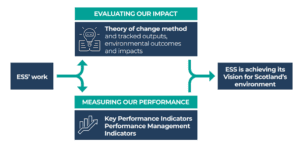
We will evaluate both the impact of our work and the effectiveness of how we work, to deliver on our Strategy 2026-2031 ambitions.
7.2
We use a theory of change approach to demonstrate how our scrutiny work has an impact on the environment. We also utilise key performance indicators (KPIs) and performance management indicators (PMIs) to measure our organisational performance.
7.3
Together these approaches will enable us to assess how well we are achieving our vision.
7.4
For each of our major investigations and analytical projects that make recommendations for improvement, we will prepare a theory of change to explain how the actions taken by ESS are expected to contribute ultimately to improved environmental outcomes.
7.5
We will include details of these in our publications which are published on our website.
7.6
Each theory of change will set out the intended improvements to environmental law and regulation, the chain of events that is expected to result in improvements, any key assumptions that underpin our theory of change and the wider context.
7.7
Each theory of change will also identify specific indicators that ESS will use to track improvements in areas of the environment in which ESS has acted.
7.8
In addition to these indicators, we will commission detailed case studies on a three-yearly basis to examine the long-term outcomes of our work and ESS’ contribution to changes in law, policy and regulation which will be published on our website.
7.9
Those improvements should, alongside other contributing factors, lead to better environmental outcomes for nature and people and contribute to the achievement of Scotland’s ambitions for the environment and climate change.
7.10
We also measure our organisational effectiveness on a regular basis using PMIs and KPIs.
7.11
Our PMIs set out below include a wide range of operational and management information related to our investigation and analysis work, our engagement and profile, delivery against our People Strategy pillars, delivery of our annual Business Plan objectives and compliance with governance and financial reporting requirements set out below.
7.12
These PMIs are organised under three KPIs:
This will enable us to describe and explain our progress each year in a qualitative and quantitative way.
7.13
The first year of reporting performance against these KPIs and PMIs will be at the end of the financial year April 2026 to March 2027. All PMI data will be made available on the ESS website each year, and published alongside the Annual Report and Accounts by end of October.
7.14
In the annual report and accounts, a revised performance management section will be added, which will focus on a descriptor of progress under the three KPIs. In this section, we will indicate whether we have: met, partially met, or not met our ambitions in this area.
7.15
Our KPIs will remain constant across the period of this Strategy. However, to enable a flexible approach, and to build more challenge into our KPIs over time, we will regularly review our PMIs, which may be added to, or enhanced, where additional insight is required.
| Performance management indicator being measured in 2026/27 | Key performance indicator: Performance;
People; Profile |
Strategy 2026-2031 strategic objective |
| ESS contribution to long-term environmental outcomes | Performance | Objective 1
Objective 2 Objective 3 Objective 4 Objective 5 |
| Casework completed | Performance | Objective 1
Objective 2 Objective 5 |
| Casework resulting in enforcement action | Performance | Objective 1
Objective 2 |
| Percentage of enforcement action accepted/implemented | Performance | Objective 1
Objective 5 |
| Number and proportion of issues resolved informally | Performance | Objective 1
Objective 2 Objective 5 |
| Percentage of casework completed within expected timescales | Performance | Objective 5 |
| Number and type of (investigation) inquiries received | Performance | Objective 4
Objective 5 |
| Number of outputs from analytical work | Performance | Objective 2
Objective 3 |
| Percentage of recommendations / actions from analytical work: accepted; progressing; or delivered | Performance | Objective 1
Objective 2 Objective 3 |
| ESS responses to Parliament and Government consultations | Performance
Profile |
Objective 3 |
| Stakeholder perception of ESS role | Performance
Profile People |
Objective 4
Objective 5 |
| Number of public/ stakeholder engagement sessions | Performance
Profile People |
Objective 4
Objective 5 |
| Number of citations in the Scottish Parliament Official Report | Performance
Profile |
Objective 4
Objective 5 |
| Social media engagement rate | Performance
Profile |
Objective 4
Objective 5 |
| ESS website page views | Performance
Profile |
Objective 4
Objective 5 |
| Service standards met | Performance
Profile |
Objective 4
Objective 5 |
| Progress against the ESS People Strategy | People
Performance Profile |
Objective 5 |
| Progress against corporate reporting | Performance
Profile |
Objective 5 |
| Number of complaints received | Performance
Profile People |
Objective 5 |
| Progress against the ESS Sustainability Plan | Performance
People |
Objective 5 |
Key:
Objective 1. Securing compliance and improving effectiveness
Objective 2. Analysing and investigating environmental concerns
Objective 3. Monitoring and scrutinising environmental performance
Objective 4. Engaging and communicating effectively
Objective 5. Being an efficient and effective organisation