• Corporate Reports
  • 24 March 2026

1. Foreword

Mark Roberts, Chief Executive of ESS

Mark Roberts, Chief Executive of ESS

Critical to the success of ESS is our ability to communicate well.

This Communications and Engagement Plan has been formed alongside the development of our ESS Strategy both of which come into existence four years on from our inception.

As our organisation continues to change and develop, so does the communications environment that we are working in. However, one constant is our commitment to communicate with purpose and to be the leading authority on the implementation of environmental law in Scotland. We will continue to communicate with clarity, providing insights into our work and sharing our expertise. Our messaging will be intentional – delivered where and when it creates meaningful impact.

This Plan sits underneath the ESS Strategy 2026 – 2031 and sets out the communications and engagement approach, priorities and actions that we will undertake over the next five years to help support ESS in meeting its main Strategic Objectives.

We will conduct our communications and engagement with the public in an independent, trusted, transparent and effective manner, and each of these characteristics will inform our actions that align with our communication priorities and support the delivery of our main Strategic Objectives. By doing so, we hope to build upon the public’s trust in us and understanding of our role in ensuring the effectiveness of, and compliance with, environmental law in Scotland.


Mark Roberts

Chief Executive of Environmental Standards Scotland

2. Introduction and the ESS Strategy 2026 - 2031

2.1 

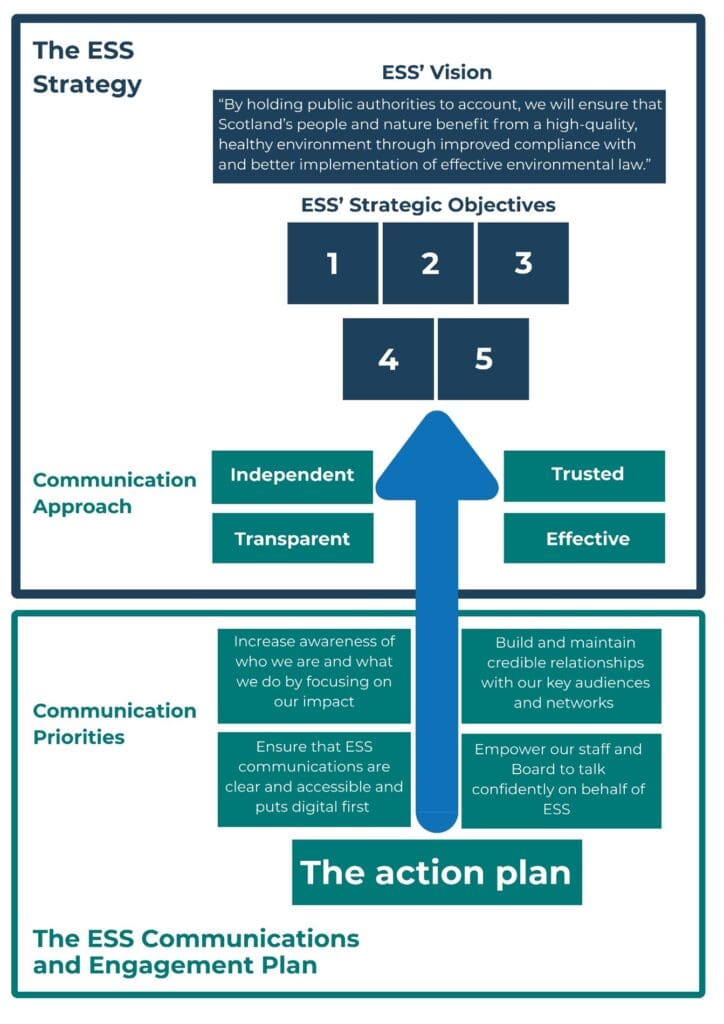
This Communications and Engagement Plan (the Plan) has been prepared alongside the development of the main ESS Strategy 2026 – 2031 (the Strategy). The Plan sits underneath the Strategy and successful implementation of the activities in the action plan (set out at Annex 1) will support the organisation in meeting its Strategic Objectives

2.2

ESS’ vision is set out in the Strategy. It states that:

“By holding public authorities to account, we will ensure that Scotland’s people and nature benefit from a high-quality, healthy environment through improved compliance with and better implementation of effective environmental law.”

2.3

To help the organisation achieve its vision for Scotland’s people and nature, the Strategy outlines five key objectives:

  • objective 1: securing compliance and improving effectiveness
  • objective 2: analysing and investigating environmental concerns
  • objective 3: monitoring and scrutinising environmental performance
  • objective 4: engaging and communicating effectively
  • objective 5: being an efficient and effective organisation

2.4

This Plan outlines the current communication context for ESS. It then goes on to highlight ESS’ communication approach and communication priorities, before setting out a series of actions that will assist in meeting ESS’ main Strategic Objectives. The Plan concludes with information on how we will measure our success.

2.5

When shaping our action plan, we have focused on our communication and engagement priorities and ensured the activities flow directly from them. As a result, each activity in the action plan is aligned with a communication priority and will assist in the fulfilling of one or more of the ESS Strategic Objectives. Our communication approach comprises of the characteristics and principles that will guide how we will communicate and engage with our key audiences and stakeholders.

2.6

This Plan refers to ESS’ external communications only. ESS’ approach and associated actions related to its internal communications and human resources, are set out in the ESS People Strategy 2024-2026.

The relationship between the ESS Communications and Engagement Plan and the ESS Strategy

Figure 1: The relationship between the ESS Communications and Engagement Plan and the ESS Strategy

3. Context

3.1

Scotland’s communication environment has changed. Scotland’s media has experienced a rapid move away from traditional print newspapers and broadcast towards digital editions and online streaming services. Audiences now consume news from a variety of channels and choose when and where to engage often prioritising control, choice and convenience.

3.2

This change has taken place against a backdrop of growing disinformation online – eroding trust in our public institutions – and uncertainty about the future and reliability of social media platforms. The increase in the use of artificial intelligence (AI) will also impact future communications for public bodies like ESS.

3.3

Furthermore, communications concerning Scotland’s environment and environmental law must vie for attention in a competitive and crowded news agenda, often dominated by domestic policy pressures and global affairs.

3.4

This context poses both challenges and opportunities for how ESS must communicate and engage with the public. Our communications approach, priorities and action plan have been developed with this context in mind.

3.5

The period of this Plan will cover the Scottish Parliament elections in 2026, where we can expect a significant turnover of MSPs, including on key committees, and a new legislative agenda. A Communications and Engagement Plan that focuses on our four communication priorities will put ESS in a strong position to introduce the organisation to the new parliament and build upon our successful engagement with MSPs over the last four years.

3.6

The period of this Plan will also cover the preparation, integration and delivery of new aspects of scrutiny for ESS. This includes scrutinising local authorities’ delivery and reporting of their climate change duties and acting as a new Independent Review Body for scrutinising progress towards the delivery of Scotland’s statutory targets for nature recovery. The communications team at ESS will have a role to play in communicating these new scrutiny powers to the public and ensuring there is an understanding of ESS’ new functions.


4. Our approach

4.1

The ESS Strategy outlines our communications approach and the principles that will guide how we will communicate and engage with the public. The Strategy states our communications approach will be:

  • independent
  • trusted
  • transparent and
  • effective

4.2

By placing these principles at the forefront of how we will approach our communications and engagement work, we will strive to ensure that we are a respected and accountable organisation that enjoys public confidence in what we do. More information on what each of these characteristics will mean for how we will conduct our work is provided in the table below.

4.3

We will implement the activities detailed in our action plan (page 14) guided by this communications approach.

ESS Communication Approach For example:
Independent  We will communicate our findings and views through our communication channels with a distinct and confident voice free from bias and influence
Trusted We will ensure that the content of all our work is factual and objective, and will communicate in a timely and consistent manner
Transparent We will publish all our procedures, updates on our progress and our completed work, and will explain our findings
Effective We will outline why our work is relevant to the people of Scotland and the Scottish environment in a clear and accessible way and communicate the longer-term outcomes of our findings and recommendations

4.4

ESS is also committed to using data and statistics in line with the principles of trustworthiness, quality and value set out in the Code of Practice for Statistics, and we have voluntarily adopted the Code to demonstrate the high standards applied to our quantitative work.

5. Our communication and engagement priorities

5.1

This Plan sets out four main communication and engagement priorities for ESS. Each activity in our action plan will flow directly from one of these four priorities. In doing so, we will organise and give precedence to communication activities that support the communication priorities of our organisation.

5.2

We have chosen to prioritise:

  • increasing awareness of who we are and what we do by focusing on our impact
  • building and maintaining credible relationships with our key audiences and networks
  • ensuring that ESS communications are clear and accessible and put digital first
  • empowering our staff and Board to talk confidently on behalf of ESS
Priority one: increase awareness of who we are and what we do by focusing on our impact

5.3

ESS has a positive story to tell about how our work is leading to change when it comes to improving the effectiveness of environmental law, compliance with the law, and how that law is implemented and applied in Scotland. We will prioritise putting this success story front and centre of our communications and by doing so, increase public awareness of our organisation and the good work that we are doing. By undertaking activities that align with this priority, we will work to position ESS as a driver of change and a needed and valued public body in Scotland.

5.4

When communicating our impact, we will focus on work that we have published in our analytical and investigative work and draw upon theories of change to explain how our actions will have a positive long-term impact on the environment. However, we will also look for opportunities to publicly connect ESS to wider issues of environmental law where it is a subject matter we have completed work on or have expertise in. For example, we will seek to broaden public awareness of our responses to consultations and committee appearances in the Parliament.

Priority two: build and maintain credible relationships with our key audiences and networks

5.5

We will prioritise being a well-connected and networked organisation that is trusted by its key audiences and stakeholders. We will engage regularly, and at a variety of levels, with a broad range of stakeholders, including the public authorities we scrutinise.

5.6

We will use a variety of communication channels to ensure that we reach our key audiences where they spend their time. We will also undertake and commission research to fully understand our audiences’ concerns and priorities so that we can engage with them in an effective and meaningful way.

Priority three: ensure that ESS communications are clear and accessible and put digital first

5.7

The nature of ESS’ work is complex and specialised. We will therefore prioritise clear communication and make every effort to use plain language that can be widely understood. We will also ensure our communications are accessible and inclusive of people with different needs. We will consider accessibility standards across our work and embrace opportunities to produce easy read documents and summaries where it is appropriate to do so.

5.8

We will adopt a digital-first approach, ensuring our messages reach audiences on the platforms that they use, and where they increasingly spend their time – online.

Priority four: empowering our staff and Board to talk confidently on behalf of ESS

5.9

Although the day-to-day work of communications and engagement outlined in the action plan will be undertaken by the ESS communications team, we are mindful that all staff at ESS have a role and responsibility to communicate and engage well with the public and our key networks. We will continue to prioritise integrating our communications approach and priorities across the organisation to ensure a one-team approach to our communications and engagement.

5.10

We will also draw upon the experience and expertise of members of the ESS Board to enhance our engagement with our key stakeholders. The communications team will support the Board to develop a plan for this engagement and will update the activities in the Action Plan to reflect the Board’s feedback and preferences.

The relationship between the ESS Communications and Engagement Plan and the ESS Strategy

Figure 2: Scotland’s communication context and ESS’ communication approach and priorities

6. Our audience

6.1

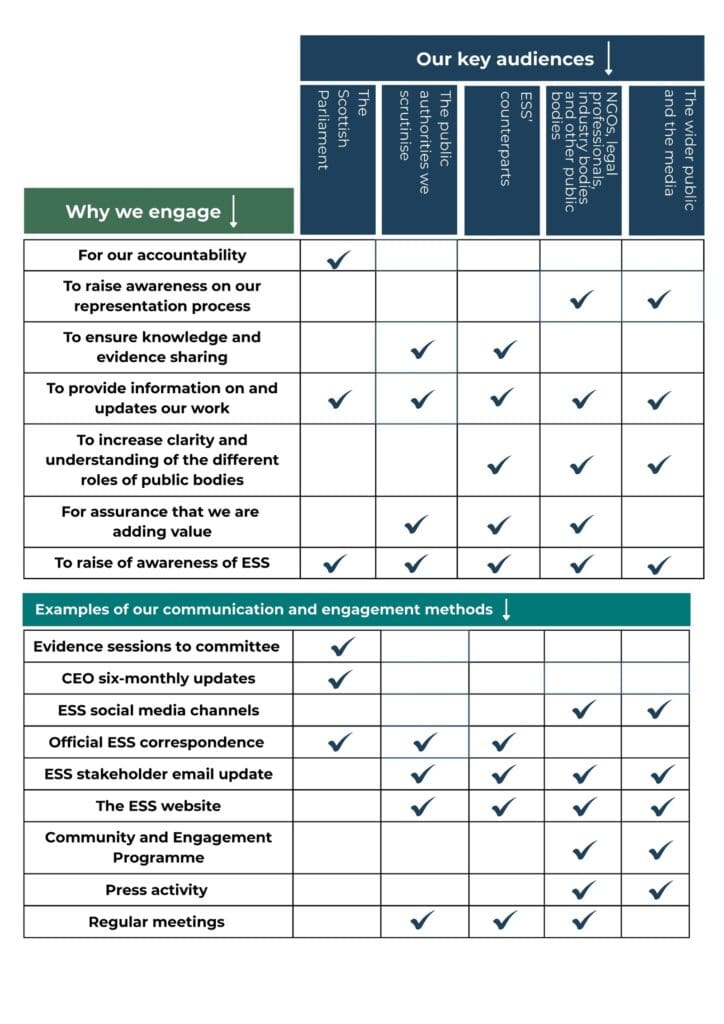
As an independent public body working on compliance with, and the effectiveness of environmental law in Scotland, we recognise that our area of focus is specialised and will resonate most strongly with those that share a direct interest in our work on environmental law. As a result, one of our primary audiences will be the Scottish Parliament to whom we are accountable, and the public authorities that we scrutinise, including but not limited to: the Scottish Government; the Scottish Environment Protection Agency; NatureScot; and local authorities. In addition, any individual or organisation that makes a representation to ESS on an issue of environmental law, will be a key audience for us.

6.2

Scotland has a robust and vibrant group of environmental non-governmental organisations (NGOs) and organisations to whom we will prioritise respectful and meaningful engagement with to increase an understanding of our role and broaden awareness of our work. We will continue to engage with the legal profession who specialise in environmental law and strengthen our connections with other public bodies in Scotland to support clarity around our respective roles and promote effective knowledge sharing. We will also engage with industry bodies to ensure their views are considered in our work.

6.3

To ensure that we are adding value through our work and to share knowledge and evidence in our common areas of interest, we will seek to engage with and communicate regularly with our counterparts at the Office for Environment Protection (OEP) in England and Northern Ireland, and the Interim Environmental Protection Assessor for Wales (IEPAW).

6.4

Despite the specialised nature of our work, as a publicly funded organisation we will take every opportunity to share our findings with the wider public in Scotland. With a clear ESS brand, active digital presence, and engagement with the Scottish press, we will work to ensure more people in Scotland understand who we are, what we do and how they can raise concerns with us on any issue regarding compliance with or effectiveness of, environmental law.

6.5

We will continue to engage in person with communities (particularly under-represented and disadvantaged groups) across the mainland and islands of Scotland to understand and discuss the environmental issues which affect them. This work is done through our Community Engagement Programme that will continue to promote and explain ESS’ role, ensuring that it is widely understood and that communities and individuals are confident in raising their environmental concerns with us.

6.6

We are mindful that as an independent public body we may receive public criticism about the outcomes of our work. We will respond to any criticism in a respectful and timely manner, explaining the decisions of the organisation with a balanced and fair voice. Our investigation and analytical operational guidance will remain updated on the ESS website so the public can understand our processes, including our decision making on how we will handle public representations.

Why and how ESS engages with its key audiences

Figure 3 – Why and how ESS engages with its key audiences

7. Action plan and measuring our success

7.1

Our action plan outlines a series of communication and engagement activities we will undertake to assist ESS towards the delivery of its Strategic Objectives. The activities outlined in our action plan have been informed by our communications approach and carefully crafted to ensure they each flow from a specific communication and engagement priority.

7.2

The action plan will be reviewed twice a year by the Executive Team. This will ensure relevant feedback and data is considered and that any published changes to the Plan fully aligns with our overall Strategy.

7.3

We will publicly report an overview of progress of the activities in our action plan as part of our Annual Report and Accounts each year alongside the specific and relevant Performance and Management Indicators (PMIs) for this Plan. These PMIs are available to view on the ESS website.

7.4

A Theory of Change will be developed for this Plan that will explain the long-term impact we hope to achieve through the successful delivery of the action plan activities. The Theory of Change will include indicators of how we will measure our success including, but not limited to, growth in social media engagement, the number of ESS community engagement events, ESS perception survey feedback, website metrics and mentions of ESS in the official report of the Scottish Parliament and Scottish press.


Annex 1: ESS Communications and Engagement Action Plan

Not all actions have specific monitoring criteria set against them, as some are still in development, for example in relation to ESS’ new scrutiny duties.

As these are finalised, they will be listed within the live internal action plan. The internal live action plan also contains more detail on lead responsibilities and new developments.

Key:

ESS Strategic Objectives:

Objective 1: Securing compliance and improving effectiveness
Objective 2:  Analysing and investigating environmental concerns
Objective 3: Monitoring and scrutinising environmental performance
Objective 4: Engaging and communicating effectively
Objective 5: Being an efficient and effective organisation

Communication priorities:

Awareness/impact Increase awareness of who we are and what we do by focusing on our impact
Audiences Build and maintain credible relationships with our key audiences and networks
Clear/accessible/digital Ensure that ESS communications are clear and accessible and put digital first
Empower Empowering our staff and Board to talk confidently on behalf of ESS


ESS Strategic Objective Communication priority Action
1, 2, 3, 4, 5 Awareness/impact We will create a page on the ESS website detailing the major success stories of ESS as a driver of change on the compliance and effectiveness of environmental law in Scotland.
1, 2, 3, 4, 5 Awareness/impact We will create a series of graphics for ESS’ social media channels to communicate ESS’ Theories of Change on the long-term impact of its work.
1, 2, 3, 4, 5 Awareness/impact  We will communicate the impact of ESS beyond our published reports and look to engage stakeholders and media on ESS responses to consultations and participation at evidence sessions in Parliament.
2, 4 Awareness/impact  We will undertake wider press engagement on the back of ESS correspondence that is related to the recommendations in ESS analytical reports.
1, 2, 4 Awareness/impact  We will communicate the main findings of ESS investigations and analytical reports to the Scottish press, including TV broadcast, print and radio.
1, 2, 4 Awareness/impact  We will communicate the main findings of ESS investigations and analytical reports on the ESS website and social media channels.
4 Awareness/impact  We will create a series of short animations/videos to explain who we are, what we do, and how the public can make representations to us, to highlight on our social media, website, and presentations to our key stakeholders.
4, 5 Awareness/impact  We will create a Theory of Change for the Communications and Engagement Plan.
4 Awareness/impact  We will share bitesize videos of ESS’ key moments in appearances to committees in Parliament.
4 Awareness/impact  We will take part in the Holyrood public bodies communications guide annually.
1, 2, 3, 4, 5 Awareness/impact  We will continue to co-ordinate our communications with OEP and IEPAW to strengthen our collaborative approach.
4 Audiences We will introduce a six-monthly update email to key stakeholders outlining important ESS work and news about the organisation.
4 Audiences We will undertake an awareness campaign to increase the number of stakeholders that have signed up to receive the ESS email update.
2, 4 Audiences We will continue to develop and expand upon the success of the Community Engagement Programme.
4 Audiences We will continue to develop contacts with Scottish press and media that specialise in the environment/climate change.
4 Audiences We will commission an annual MSP survey on their perception and awareness of ESS, and include a question on their preferences for new organisations communicating with them at the start of a new Parliament.
3, 4 Audiences We will continue to build relationships with communications professionals in other public sector bodies in Scotland.
4 Audiences We will create a communications and engagement strategy for introducing ESS to MSPs in the new Parliament.
3, 4 Audiences We will create an engagement strategy for informing key stakeholders on new aspects of ESS scrutiny duties.
4 Audiences We will help organise and participate in a stall to introduce ESS to parliamentarians following the 2026 elections.
4 Audiences We will continue to build relationships with the legal profession to raise awareness of our work.
4 Audiences We will look for opportunities to participate as guest contributors to blogs and newsletters of environmental NGOs and community groups across Scotland to share information about who we are and what we do.
4 Clear/accessible/digital We will publish a two-pager on the ESS website detailing in plain and accessible language the main findings and outcomes of each item of our major work.
4 Clear/accessible/digital We will launch an ESS account on Bluesky.
4 Clear/accessible/digital We will verify the ESS account on X.
4 Clear/accessible/digital We will regularly update ESS social media channels with information about ESS’ work, using clear and accessible graphics.
4 Clear/accessible/digital We will create an ESS account on Canva to help create graphics and ensure ESS design templates can be edited in-house by ESS communications staff.
4 Clear/accessible/digital We will create graphic templates for social media for ESS reports, consultation responses and statements.
4 Clear/accessible/digital We will integrate the ESS chatbot on the ESS website to help assist in the search function.
4 Clear/accessible/digital We will improve the existing search function on the ESS website.
4 Clear/accessible/digital We will publish easy read documents on key aspects of ESS’ work, including the ESS Strategy.


4 Clear/accessible/digital We will produce an animation on the new ESS Strategy 2026 – 2031.
4 Clear/accessible/digital We will produce an animation on the ESS Annual Report and Accounts each year.
4 Clear/accessible/digital We will create a page on the ESS website to clearly sign-post users to the right public body for their inquiry.
4 Clear/accessible/digital We will review and where appropriate, update the ESS accessibility guidelines document, to ensure it meets the latest guidance on accessibility requirements for public bodies.
4 and 5 Clear/accessible/digital We will create a page on the ESS website to publish information on ESS’ PMIs and Theories of Change.
4 Clear/accessible/digital We will continue to improve and build on the video produced on the back of the Chief Executive’s six-monthly updates to Parliament.
4 Clear/accessible/digital We will undertake a review of the ESS brand five years on from the organisation’s inception.
4 and 5 Empower We will ensure ESS communications staff attend project meetings to enable a clear understanding of our work across the lifetime of a project.
4 and 5 Empower We will work with colleagues to provide learning and development to ESS staff on communications so that staff can speak to stakeholders with confidence.
4 and 5 Empower We will continue to provide media summaries for ESS staff and Board members detailing key political/parliamentary publications and news stories of the week, including where ESS has been mentioned.
4 and 5 Empower We will organise committee training for ESS staff.
4 and 5 Empower We will present the findings of the MSP perception survey to ESS staff.
4 and 5 Empower We will consult with staff on wider initiatives such as ‘meet the staff’ and ‘specialist subject matter’ videos and website updates.
4 and 5 Empower We will undertake a stocktake of ESS subscription accounts and ensure staff and Board members have access to the publications that they need.
4 and 5 Empower We will support the co-ordination and distribution of internal publication timelines for major pieces of ESS’ work for relevant ESS staff.
4 and 5 Empower We will manage and update the communications planner, so ESS staff can track upcoming publications across the organisation.
4 and 5 Empower We will assist in the co-ordination of preparation sessions for ESS’ appearances before Parliamentary committees with a focus on highlighting the impact of ESS’ work
4 and 5 Empower We will produce key talking point briefings for ESS staff and Board members
Back to top