Theory of Change
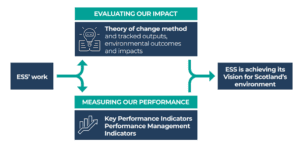
For each of our major investigations and analytical projects that make recommendations for improvement, we will prepare a theory of change to explain how the actions taken by ESS are expected to contribute ultimately to improved environmental outcomes.
We will include details of these in our publications which are published on our website.
Each theory of change will set out the intended improvements to environmental law and regulation, the chain of events that is expected to result in improvements, any key assumptions that underpin our theory of change and the wider context.
Each theory of change will also identify specific indicators that ESS will use to track improvements in areas of the environment in which ESS has acted.
Long-term outcomes
In addition to these indicators, we will commission detailed case studies on a three-yearly basis to examine the long-term outcomes of our work and ESS’ contribution to changes in law, policy and regulation which will be published on our website.
Those improvements should, alongside other contributing factors, lead to better environmental outcomes for nature and people and contribute to the achievement of Scotland’s ambitions for the environment and climate change.
Key Performance Indicators (KPIs) and Performance Management Indicators (PMIS)
We also measure our organisational effectiveness on a regular basis using PMIs and KPIs.
Our PMIs include a wide range of operational and management information related to our investigation and analysis work, our engagement and profile, delivery against our People Strategy pillars, delivery of our annual Business Plan objectives and compliance with governance and financial reporting requirements set out below.
These PMIs are organised under three KPIs: Performance, People and Profile. This will enable us to describe and explain our progress each year in a qualitative and quantitative way.
The first year of reporting performance against these KPIs and PMIs will be at the end of the financial year April 2026 to March 2027. All PMI data will be made available on the ESS website each year, and published alongside the Annual Report and Accounts by end of October.
In the Annual Report and Accounts, a revised performance management section will also be added, which will focus on a descriptor of progress under the three KPIs. In this section, we will indicate whether we have: met, partially met, or not met our ambitions in this area.
Our KPIs will remain constant across the period of this Strategy. However, to enable a flexible approach, and to build more challenge into our KPIs over time, we will regularly review our PMIs, which may be added to, or enhanced, where additional insight is required.
Please note, information related to the previous set of PMIs related to ESS’ work is set out in past Annual Reports and Accounts which are published on our website.
Strategic Objectives:
Objective 1. Securing compliance and improving effectiveness
Objective 2. Analysing and investigating environmental concerns
Objective 3. Monitoring and scrutinising environmental performance
Objective 4. Engaging and communicating effectively
Objective 5. Being an efficient and effective organisation
| Performance management indicator being measured in 2026/27 |
Key performance indicator: Performance;
People; Profile |
Strategy 2026-2031 strategic objective |
| ESS contribution to long- term environmental outcomes |
Performance |
Objective 1
Objective 2
Objective 3
Objective 4
Objective 5 |
| Casework completed |
Performance |
Objective 1
Objective 2
Objective 5 |
| Casework resulting in enforcement action |
Performance |
Objective 1
Objective 2 |
| Percentage of enforcement action accepted/implemented |
Performance |
Objective 1
Objective 5 |
| Number and proportion of issues resolved informally |
Performance |
Objective 1
Objective 2
Objective 5 |
| Percentage of casework completed within expected timescales |
Performance |
Objective 5 |
| Number and type of (investigation) inquiries received |
Performance |
Objective 4
Objective 5 |
| Number of outputs from analytical work |
Performance |
Objective 2
Objective 3 |
| Percentage of recommendations / actions from analytical work: accepted; progressing; or delivered |
Performance |
Objective 1
Objective 2
Objective 3 |
| ESS responses to Parliament and Government consultations |
Performance
Profile |
Objective 3 |
| Stakeholder perception of ESS role |
Performance
Profile
People |
Objective 4
Objective 5 |
| Number of public/ stakeholder engagement sessions |
Performance
Profile
People |
Objective 4
Objective 5 |
| Number of citations in parliamentary reports or meetings |
Performance
Profile |
Objective 4
Objective 5 |
| Social media engagement rate |
Performance
Profile |
Objective 4
Objective 5 |
| ESS website page views |
Performance
Profile |
Objective 4
Objective 5 |
| Service standards met |
Performance
Profile |
Objective 4
Objective 5 |
| Progress against the ESS People Strategy |
People
Performance
Profile |
Objective 5 |
| Progress against corporate reporting |
Performance
Profile |
Objective 5 |
| Number of complaints received |
Performance
Profile
People |
Objective 5 |
| Progress against the ESS Sustainability Plan |
Performance
People |
Objective 5 |